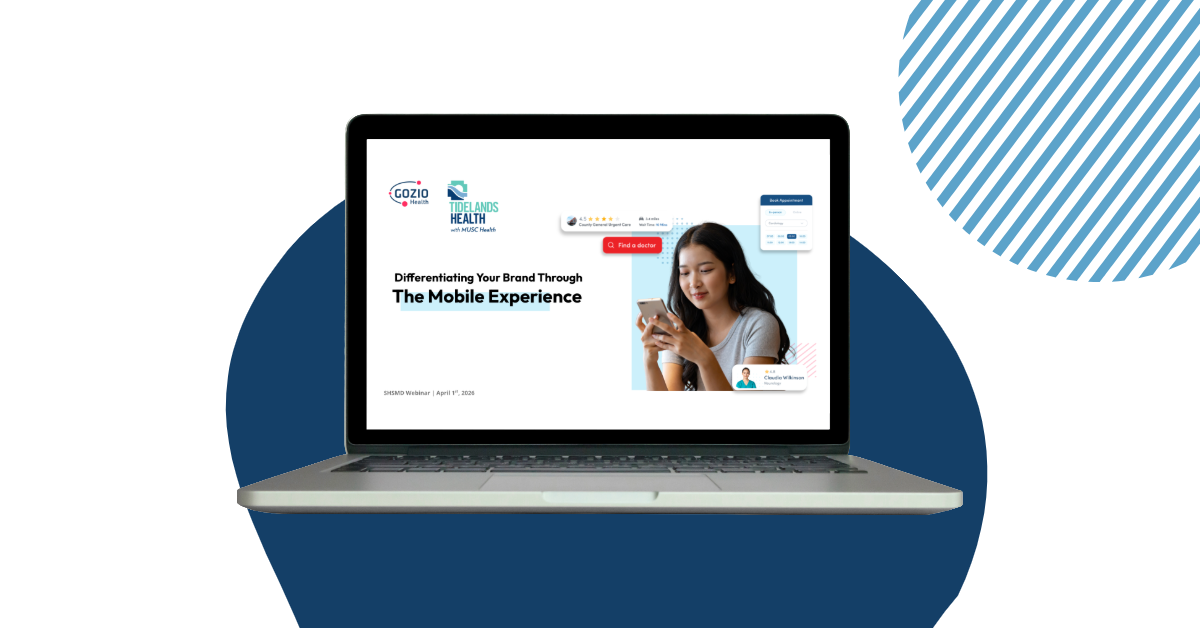
Tidelands Health is a health system just south of Myrtle Beach, sitting in the fastest-growing metro in the country. When their growth outpaced their ability to deliver a seamless patient experience, the fallout was hard to miss: months-long appointment waits, declining Google ratings, and frustrated patients sounding off on social media.
In a recent SHSMD webinar, Amy Stevens (VP and Chief Marketing Officer) and Josh Williams (Director of Integrated Marketing) at Tidelands Health joined Katie Logan, Chief Strategy Officer at Gozio Health, to share how they turned things around with a mobile-first strategy. Here are four insights worth bringing back to your team.
1. Marketing Should Be in the Driver's Seat on Mobile
When patient experience starts slipping, the instinct in many organizations is to treat it as an ops problem or an IT ticket. At Tidelands, marketing took the lead on mobilizing the effort, though Amy Stevens was clear that success depended on partnership across the organization.
"There is no campaign, the best campaign in the world, that was going to fix this," she said. "It's not a marketing-only problem, it's not a marketing-only fix." But marketing's cross-functional vantage point, spanning brand, communications, digital, and patient engagement, made the team uniquely equipped to connect the dots between what patients were experiencing and what the organization needed to change.
One of the keys to success was ensuring that this aligned with their other initiatives. Tidelands was deep into an EHR implementation, and no other department had the bandwidth to take on a parallel mobile initiative. Marketing seized the moment: "We were saying, hey, we see an opportunity... and we're not gonna ask you to do the heavy lifting. We're gonna step up."
That approach, leading without overstepping, unlocked organizational trust. And the results back it up: since launching the My Tidelands Health app alongside their new EHR in March 2024, the system surpassed 30,000 downloads in the first two months alone, with sustained, ongoing engagement.
2. You Can't Go It Alone (And You Shouldn't Try)
A great idea without organizational buy-in goes nowhere. Amy and Josh were upfront about the pushback they faced early on, from questions about cost and timing to concerns about who would own the initiative and how it would fit alongside existing priorities.
The key to getting past those objections? Data. Before proposing any solution, the Tidelands team did the groundwork. They audited their patient engagement surveys to make sure they were asking the right questions, and they launched a virtual Patient and Family Advisory Council, an opt-in panel now exceeding 15,000 members that can be surveyed in real time on specific issues. That kind of evidence made it a lot harder for stakeholders to push back.
But data alone wasn't enough. It also required bringing compliance, IT, operations, and finance to the table, not as approvers, but as partners. "Those folks are some of my best allies in this organization, and you need them to be your best allies," Amy said. "If you want this to work, and not just be the flavor of the month... it can't just be 'well, that's what marketing's doing.' It's got to be, 'this is what the organization is doing.'"
Josh reinforced the point: "We didn't start with the idea of an app and try to back into a reason to do it. It really started with that patient feedback... Talking to those other departments is a lot easier when you've got a really good business case backed up by some solid reasoning."
That alignment paid real dividends. Tidelands saw calls per visit drop 25% in primary care and overall call volume decline even as patient volume grew, the kind of metrics that get operational leaders on board fast.
3. Don't Build a Beautiful Front Door with Cardboard Behind It
Amy had a great analogy for this one: "Imagine that you build the world's most beautiful front door, but when you open it, there's just cardboard behind it."
It can be tempting to jump on mobile before the underlying systems are ready. But the Tidelands team was intentional about waiting until the foundation was solid. Their existing tools for online scheduling and bill pay weren't intuitive, and the core capabilities patients would expect to use inside an app simply weren't good enough yet.
When they decided to implement a new patient portal, that changed the equation and the timing was finally right. And rather than launch the app quietly, Tidelands went all-in on the same day as their EHR go-live. The message to patients wasn't "here's our new app." It was, as Josh put it, "Look how easy it is to interact with us now."
That operational foundation, paired with the mobile experience, helped Tidelands move from worst in market to first in market on measures for convenience, ease, coordination, and availability, all in just 12 months.
4. A Patient Portal Is Table Stakes. Mobile Is the Differentiator.
This was the insight that really hit home. The right patient portal is key for clinical communication: secure messaging, prescription refills, appointment scheduling, bill pay. Amy herself uses it weekly. But patients told Tidelands, clearly and repeatedly, that they wanted more.
In a market full of new residents who didn't grow up with a local healthcare system, the basics mattered most. How do I find you? Who are your doctors? What should I know before my first visit? Those aren't portal questions. They're brand and navigation questions, and they're best answered through a mobile experience that meets people where they already are.
The My Tidelands Health app was built to complement the patient portal, not compete with it. It offers turn-by-turn wayfinding (integrated with the user's preferred maps app), provider video profiles, health and wellness content, emergency weather updates, and more, all without requiring a login. That no-authentication experience was a deliberate choice. In a new-mover market, friction at the front door means losing a patient to the competitor down the street.
But just as important as what the app delivers is how it delivers it. The ability to fully brand and customize the experience while leveraging native-first design allows market differentiation and frictionless navigation of all system assets beyond the patient portal.
That platform ownership changes the dynamic entirely. Instead of competing for attention within a third-party platform, Tidelands can reach existing and new patients directly with timely, relevant information. It creates a persistent, branded presence on the patient’s most personal device that drives increased loyalty, engagement and visit volume that can scale overtime to integrate with other digital solutions aligned to organizational priorities.
"The perfect marketing solution is when you're giving patients what they want, and also what you want them to have," Amy explained. And as an owned channel, the app gives Tidelands full control over its messaging and experience. As Josh noted, "We're increasingly becoming renters of the platform and the audience." A mobile app changes that equation.
The Bottom Line: Mobile Can't Wait
If there's one thread that runs through every part of this story, it's that mobile isn't a nice-to-have anymore. It's the connective tissue between your brand, your operations, and your patient experience. It's how new patients find you, how existing patients engage with you, and increasingly, how your community judges you.
Tidelands didn't treat their app as a side project or a tech experiment. They treated it as a strategic priority, aligned it to their biggest organizational initiative, and let marketing lead the charge. The payoff was a measurable shift in patient satisfaction, brand perception, operational efficiency, and market position.
For health systems still on the fence, Amy's advice is clear: "Don't start with the solution. Start with operations and strategy, and say, how can we be your partner in making this experience better for our patients?"
But don't wait too long to start. Patient expectations are being shaped by every other mobile experience in their lives, from banking to retail to travel. The systems that invest in mobile now will be the ones patients choose first. The ones that don't will be playing catch-up with their competitors.
If you want to catch the replay of the full webinar, you can watch here.