Everything health systems need to know about digital wayfinding — from the real cost of lost patients to choosing the right technology, evaluating vendors, and deploying in MyChart.
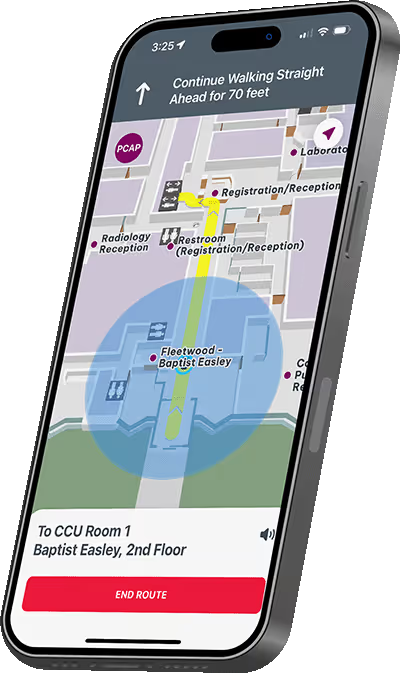
Poor signage and unclear navigation burden patients and staff alike, leading to stress, late or missed appointments, and costly inefficiencies.
Hospitals are among the most complex environments for navigation. GPS alone falls short indoors, and off-the-shelf tech often can’t keep up.
Thick walls, medical equipment, and large crowds disrupt positioning signals. Concrete and steel block or reflect radio waves unpredictably, making standard positioning unreliable.
Medical equipment emits energy that makes even a digital compass unreliable, limiting which signal technologies can effectively determine a device’s indoor location.
Multi-level buildings, unnamed hallways, skywalks, and sprawling campuses require deep understanding of facility structure to locate a device in a useful, actionable way.
A 20-foot GPS error outdoors keeps you on the same street. Indoors, that same error puts you in a completely different room, hallway, or floor — accuracy within a few meters is essential.
Unlike driving navigation, hospitals need to understand whether someone is a patient, visitor, or staff to determine the best routes, accessibility needs, and relevant points of interest.
Construction, new wings, shifted departments, and temporary closures mean maps and routes must be easy to update quickly — or they’ll cause more confusion than they solve.
Indoor positioning elevates the entire healthcare experience, not just getting from A to B.
Wayfinding delivers measurable returns across patient experience, operations, and revenue.
Average 32% reduction in missed appointments. Fewer no-shows means recovered revenue and better utilization.
Clear directions reduce navigation stress that compounds the anxiety patients already feel arriving at a hospital.
Free staff from 40+ hours/year of giving directions. Reduce volunteer dependency and redirect time to patient care.
New hires use wayfinding during onboarding — especially valuable during M&A activity and campus expansions.
Help patients discover ED, urgent care, and primary care options — reducing costly ER overuse.
Patient retention, reduced call volume, higher revenue per encounter, and improved digital competitiveness.
Not all wayfinding platforms are built for healthcare. Feature parity is table stakes — once vendors pass your core capability bar, four criteria separate partners built for long-term healthcare use from the ones that will cost you more after launch.
The platform should meet patients where they already are — inside a branded app, embedded in MyChart, or both. Vendors who require a separate navigation destination add back the friction you've worked to eliminate.
AI-assisted mapping tools shift QA burden to your team. Look for white-glove service — real people responsible for accuracy in your actual building, so your involvement is reviewing a finished product, not doing the work the AI left behind.
Some vendors hand off and leave you to notice when it breaks. Others guarantee positioning accuracy, stand behind uptime, and proactively update as your campus changes — determining whether your investment stays accurate five years in or quietly degrades six months after launch.
Platforms adapted from retail or office carry risk that's easy to miss in a demo. Healthcare-native vendors design for accessibility and HIPAA compliance from the start — and can confirm how they handle any PHI or patient location data before it becomes a compliance issue.
When evaluating a healthcare wayfinding platform, these are the table-stakes capabilities organized by category. Anything less puts patient experience and ROI at risk.
Real-time positioning with turn-by-turn guidance through your facility, not just outdoor maps.
Seamless transition from driving directions to walking inside — patients never lose their way.
Single platform across all locations — hospitals, MOBs, urgent care, and ambulatory sites.
Wheelchair-accessible paths, step-free routes, and assistive guidance for patients who need it.
Deploy directly inside Epic MyChart or in your own mobile app, meeting patients where they already engage with you.
Pull location from the scheduled appointment so patients tap one button to be guided there.
Route patients to the right garage, level, and entrance — with save-my-spot for the return trip.
Patients find any department, provider, or point of interest instantly by typing a name — no menus to dig through.
No third-party vendors in the navigation stack. Maps and positioning data stay in-platform.
Marketing or facilities can update POIs, closures, and content without engineering tickets.
See where patients struggle, where they go, and how usage trends to inform operational decisions.
A vendor that understands EHR workflows, M&A complexity, and the realities of clinical operations.
A solution can look flawless in a vendor demo and still fail in your actual building. Evaluate every capability on-site before you sign. At minimum:
Health systems across the country are using Gozio to transform patient navigation and drive measurable results.
“The wayfinding feature is absolutely invaluable—you’ve got to have it—but the added value of the other functionality, all in one place in the palm of your hand, is really what makes Gozio’s mobile offering unique. The ease of use is incredible.”
“What we look for is a halo effect: a patient was able to easily find patient registration, the ATM, a place to eat. Baptist Access is critical for demonstrating our commitment to the holistic experience, including all the relevant touchpoints on the way to or from the appointment.”





The questions that come up most often when evaluating digital wayfinding for healthcare.
Gozio Health partners with health systems to deliver the most accurate, reliable, and user-friendly wayfinding available today — designed exclusively for healthcare, from the way buildings are mapped to how routes are generated in complex clinical environments.
Deliver reliable, accurate blue-dot wayfinding wherever your patients are — through MyChart, a custom branded app, or your existing mobile application.
Build a fully branded mobile experience with Gozio’s platform. Unify wayfinding, scheduling, bill pay, provider search, and more.
Deploy Gozio’s wayfinding directly within Epic MyChart. Meet patients where they already engage — no standalone app required. An Epic Toolbox solution.
Already have a custom app? Integrate Gozio’s wayfinding SDK directly. Same proven navigation without rebuilding.
Your patients deserve an easy experience from scheduling to arrival. See Gozio in action.
Book a Demo →
